






By Volunteer Site Steward Jeff Roehm
It was a wet afternoon in early May when I decided I needed to walk out to the raised boardwalk that runs along the north pasture of Circle Creek Habitat Reserve. It was trying to rain, and everything was wet on the mowed grassy path. But this is the Oregon Coast, so you just put on your boots and walk on out there. There’s always something interesting, and this time would be no different. A few weeks earlier, I’d found a patch of a terribly invasive plant called yellow archangel growing on a little side trail, but I didn’t have anything to mark the location. I had a date with Melissa Reich, NCLC stewardship director, to hike back out and dig it up—so it might be a good idea to be able to find it. This time I had some small red flags that would do the trick.
Just before starting out, I was sitting in my car thinking about what I was about to do. I looked down at a pile of paper and books I always carry with me on my trips back and forth between Portland and the beach. There was a small bookmark on top of the pile that my daughter Karen had created to go with her latest book. Below the pictures of harbor seals and sea urchins was a text that said:
“Slow down, look around, be amazed”
This message was meant for readers headed for our fabulous beaches, but it works whenever you find yourself out in nature. Every cool thing I was about to see on my little two-mile walk that day was within a few feet of the trail—easy to see by anyone but just as easy to walk right past.
The Line Between Life and Death
The first thing I saw as I walked out into the north pasture was easy to notice. Just past where the mowed path divides was a group of about 20 of our resident elk.
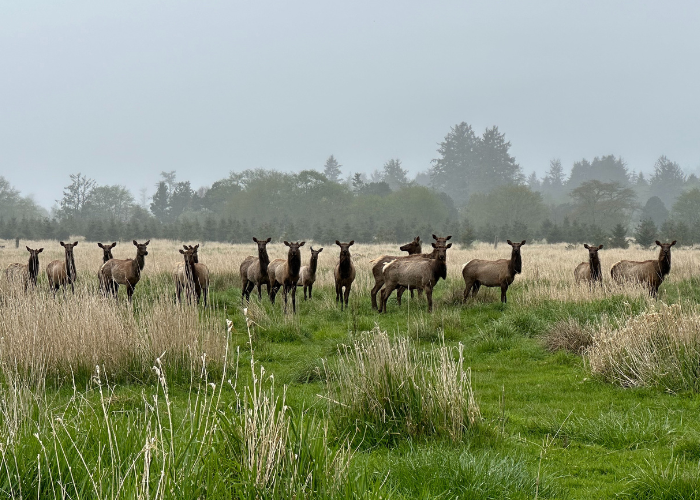
I love seeing these beautiful animals, though they don’t seem to enjoy me that much. They prance back and forth nervously and sometimes stop and just stare me down.
They’re not like the elk that we see along the highway or in peoples’ yards. To this group, I’m an obvious intruder.
They sometimes block the path to where I’m headed, or maybe they’re just a little too close, causing me to look for a plan B to get to where I was headed. I don’t want to disturb them. After all, they’re big and wild, and I think we should try to keep them that way. Here in this special place, the elk have the right-of-way for sure.
Today, they moved off to the east toward the Necanicum River, leaving the mowed path open for me. I walked through. trying not to make any quick moves. Soon I was at the beginning of the raised boardwalk, which is part of the Wetlands Walk trail that we keep open to the public. It’s a great place to look out into the forested wetland that covers almost half of Circle Creek Habitat Reserve. This is an area of rare environmental importance that in places is just plain off the charts for us humans. There’s no way anyone has ever walked through there. But you can take a peek from our raised boardwalk.
If you look out through the branches and bushes that line the path, you’ll notice there’s lots of wood out there. Many times, you’ll see what looks like a bank or ridge out of the corner of your eye, only to realize it’s actually a fallen tree, or often several trees piled one on the other.
Over time, these become topped with a dizzying array of plants and animals that simply would not be there without the wood. I don’t like to use the term logs since they’ve never left the forest. They’re just trees that are now lying on the ground, giving life to lots of things, including new trees all in a row.
In this forest the line between life and death is fuzzy at best.
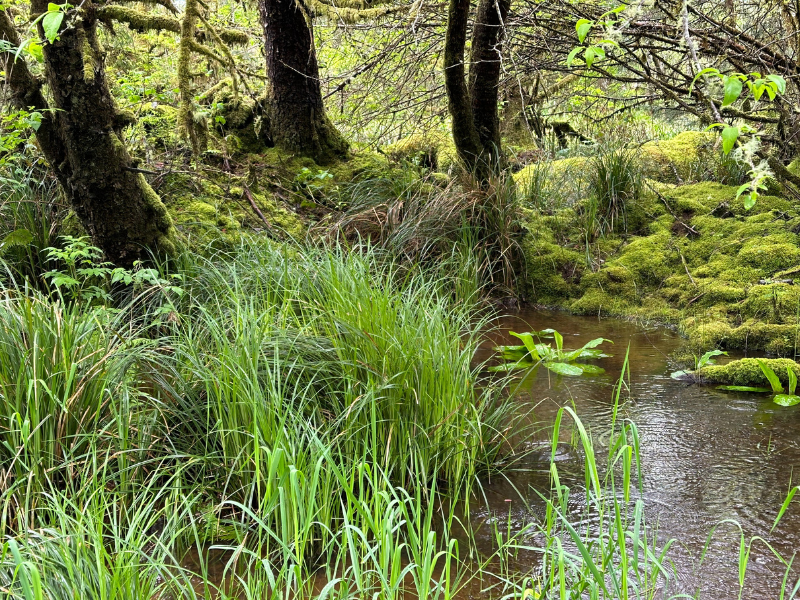
But my task this day was to find and mark that patch of invasive weeds for a return trip with Melissa. So, when I reached the boardwalk, I headed to the left along the east bank of Circle Creek on a small game trail. This is a really “elky” area marked by lots of mud and open pools where the elk have torn up the understory by just walking around.
Then, after 100 feet or so, things returned to normal, and after a few more steps, there I was at the hated weed. As I was taking a photo with my phone, I noticed the background. I’d been along this trail many times but apparently just hadn’t looked closely at what was running along beside me, even though I knew it was there. On the opposite side of the trail, away from the creek, there was a very large tree lying on the ground. This tree had long since faded into the understory after more than 100 years in the muck. I’d just walked past the stump of this tree to get here. Come on, slow down, look around.
There are only a few people who ever wander even this far off the main trail, and even fewer who would give much notice to a stump. I was out here a few years ago with NCLC founding executive director Neal Maine, along with a small group of volunteers. Neal was showing us the power of looking around, admiring this stump and sharing a fascinating story that it tells if you just give it a chance. Old stumps from around the turn of the last century have notches that once held springboards for fallers to stand on. But the notches that remain on this stump are set very low on the tree as if they were chopped out by inexperienced loggers. And then there’s the rest of the tree. There it is, stretching out from the stump, and has even been sawed into sections ready for removal from the forest. But it never was.
A Historical Perspective
On Jan. 23, 1918, The United States Army Spruce Production Division arrived in Clatsop County. They had come to log coastal Sitka spruce. This was the height of the Great War, and even though the United States had yet to fight its first battle, the newly created U.S. Army Air Corps was busy building planes and providing material for our allies in Europe to do the same. These planes had airframes made of wood, and the best wood for this purpose it was decided was Sitka spruce. So here they were, some actual loggers but mostly green recruits with no experience to speak of. What they found was lots of rain falling in a deep, dark, tangled forest with steep gullies and gulches, gooey unstable soil and water everywhere.
They set to work in this difficult terrain building two short rail spurs into the trees that hugged the coast. There were three Spruce Division camps in the Necanicum Watershed. The closest of these was at today’s Cannon Beach junction, about a mile from Circle Creek Habitat Reserve. One source I read noted that they had logged in a small watershed just north of Tillamook Head. Well okay, that sounds a lot like this place right here. They spent most of those first months building roads and rails and likely had just started to get the hang of this very dangerous job of cutting down trees when Nov. 11, 1918, arrived. The fighting in Europe came to a halt and the logging operation abruptly ended. Just after the new year the Spruce Division was gone. The only evidence that they were ever here just might be this mighty tree, still living out its destiny beside Circle Creek.
The Story the Tree Was Telling
Back to the present, about a month after that first walk with the flags, I was finally able to get Melissa out of her office and into the forest. We headed out to that yellow archangel patch armed with garden tools and a big plastic bag. Digging up this plant requires great care, since any piece of it carelessly dropped along the trail or left in the ground can become a new plant. Actually, I think our elk might be spreading it around as we’re now finding little patches way more often than we’d like. Today we also brought along a tape measure so we could learn some more about our tree that had been left for us more than a hundred years ago. This turned out to be really fun, since every measurement we took was a new sentence in the story the tree was telling.
Trees grab our imaginations for a reason. They live among us but use a very different standard of time and space. They are totally chill, staying in one place while they grow, sometimes for centuries. Given the chance, they can become very old and can likewise become very, very large. Here on the northwest Oregon Coast, our Sitka spruce have a normal life span of about 250 to 300 years. By then, their huge mass passes the limits of their shallow roots and soft soil, and they fall over when a storm catches them by surprise. Or perhaps fungi finally degrade the roots and heartwood, and the tree just falls apart in the wind. Finally, they might fall victim to a very large earthquake which causes what’s called “earthquake drop” sending many trees to the ground. However, there are exceptions. That world-record Klootchie Creek Spruce, which sits in the county park just four miles from here, had an estimated age of 789 years before it broke apart in 2007. Actually, our home here on the northern Oregon Coast is one of those special places in the world where trees can get really big. Just past that giant spruce, up the hill from our Necanicum Forest property, there once was the world’s largest Douglas-fir. This tree, named the Clatsop Fir, was the more famous of these two trees, prompting Crown Zellerback, the logging company that owned the forest, to build a road up to the tree just to show it off. Today, this once short gravel road is part of the Clatsop Fir Mainline. The tree fell over in the 1962 Columbus Day storm but much of it is still lying on the ground. The Clatsop Fir’s estimated age was 702 years. We are living in big tree central for sure.
‘Record-Sized’ Sitka Spruce
So when Melissa and I were finished digging in the mud, it was time to start reading the story that our tree was telling, starting with that really big stump. This had been done once before, back when Neal and our group had visited. But we had to start at the beginning, so we decided to re-measure. The height of the stump was impossible, since the ground wasn’t level and neither was the top of the stump. I held the tape up on the highest ground, and with Melissa sighting across we got 6 feet. We could see that other places on the stump would be much higher, but this would have to do today.
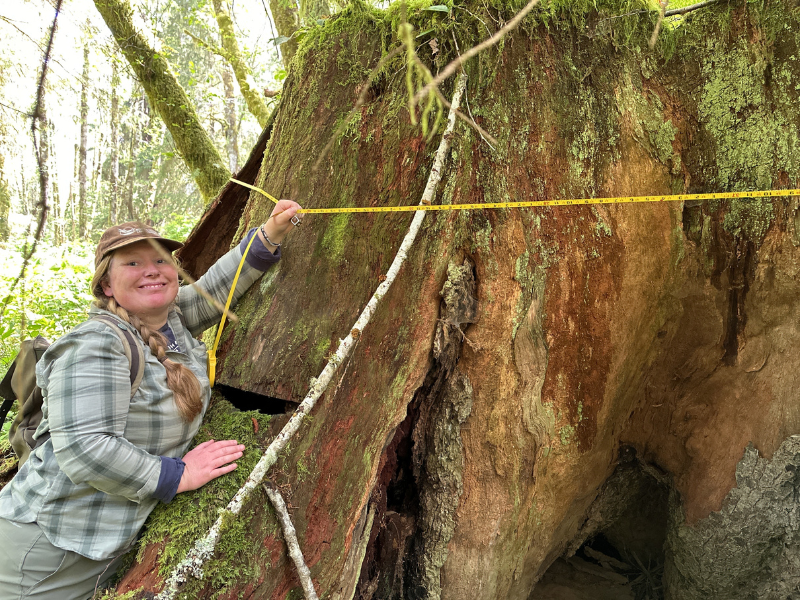
The circumference was not an easy task either with a tree this huge. I tried to keep our tape as high on the stump as possible as I climbed around the root buttress up and down through the brush back to where Melissa was holding the end of the tape against the tree.
Today the tape read exactly 40 feet. This was as good as we were going to do. With that circumference, our tree would have an average diameter at the top of its stump of just under thirteen feet! As a comparison, that world record spruce up the road had a diameter of 17 feet, so our tree as you might expect was smaller, but definitely in the same ballpark. Arno and Hammerly’s book “Northwest Trees” describes what they call “record-sized” Sitka spruce as having diameters of 12 to 17 feet.
So there you have it. Now that we’d measured our record-sized stump, it was time to turn our attention to the rest of the tree, which was lying on the ground before us.
The first bucked section is still there beside the stump, but the outer end of it is broken and the saw’s cut is short, as if they were trying to save what they could, then decided not to. The cut doesn’t go all the way through the log.
Farther out there’s a gap that’s about the right size for another section of trunk, but that section is missing. Then finally the tree starts up again out 54 feet from the stump, where a huge, exposed cut of the saw signals the beginning of the rest of the tree.
I think it’s safe to assume that this marks the tree, exactly where it landed in 1918, and it hasn’t moved since. If the tree were still standing atop its stump, with those two sections back in place, this cut would be at an elevation of about 60 feet. Then continuing out another 23 feet, there’s another cut with the bucking saw, but here the tree is starting to divide itself into two trunks, and again the cut only goes part-way through the tree.
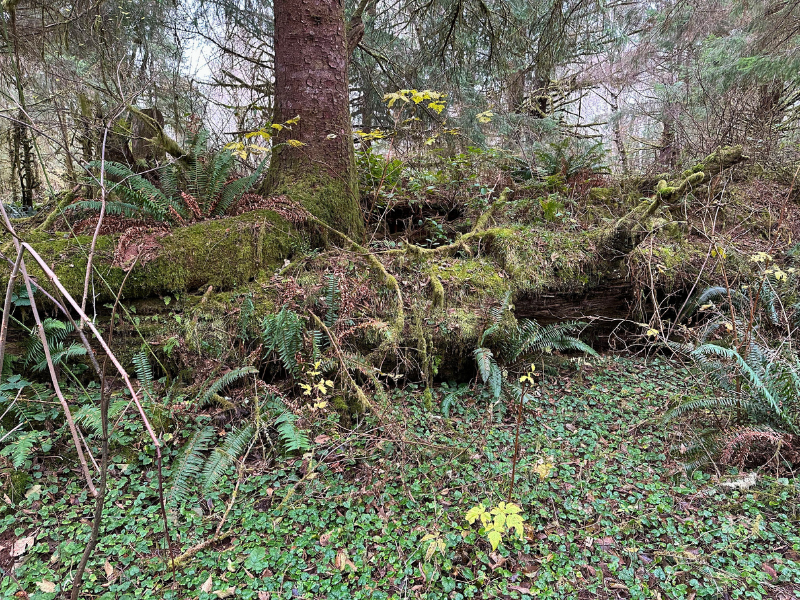
This is that weak spot where the tree just broke apart when it hit the ground. If this tree were still standing atop its stump, we would now be 83 feet up in the air! Here you can look down through an opening where the two trunks were starting to separate and actually see into the center of the tree.
The wood in there is fractured and split and looks fresh and solid, as though it’s been protected from the outside world all these years. There’s lots going on here, with two fairly large trunks going their separate ways and a new, large tree growing straight up out of the jumble of broken wood. Melissa and I did some walking around and measuring things, trying to figure it all out. What were we looking at? What happened back in 1918 when this tree came crashing down?
Well, in the first place it doesn’t seem like the tree fell like it was supposed to. When it hit the ground, those two trunks were not parallel to the forest floor. The tree was crooked, with one trunk hitting the ground first while the other was still in the air. Both trunks broke at their origin, but in different ways. The one that hit first angles down toward the ground and after about 15 feet has disappeared from view. If you walk along the bank where you imagine the trunk might be you’ll notice a weird, berm-like formation in the silt that should not be there, straight out and tree-shaped. The rest is left to our imagination.
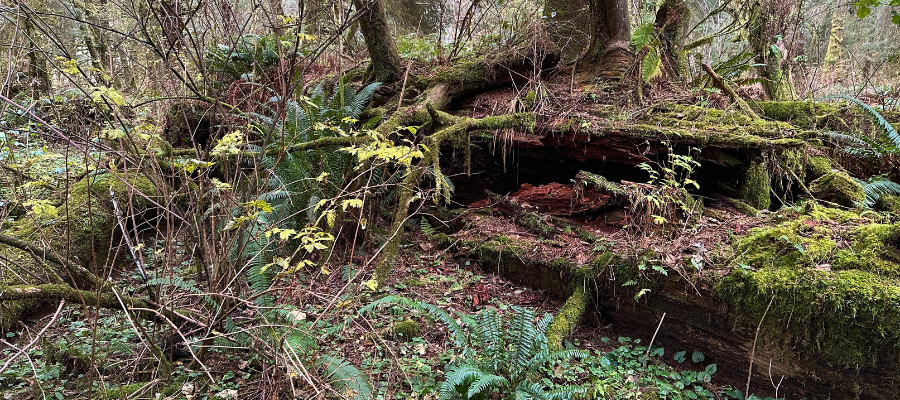
Now we turned our attention to the second trunk, which was over on the other side of this huge woodpile.
This trunk required much less imagination, since it dropped straight down and is still lying on the ground. The trunk extends out another 34 feet where it’s been cut through with a saw. The remaining trunk after this cut is gone. It was time to wind up our tape measure and join Melissa standing out at the top of today’s adventure; the farthest point of the tree we were actually able to measure.
Now we were both at the sawed-off stub of the trunk, at the point where if we imagined this tree were still standing, we would be hovering about 117 feet above the ground. This is the height where most of the trees at Circle Creek today stop, the top of the canopy.
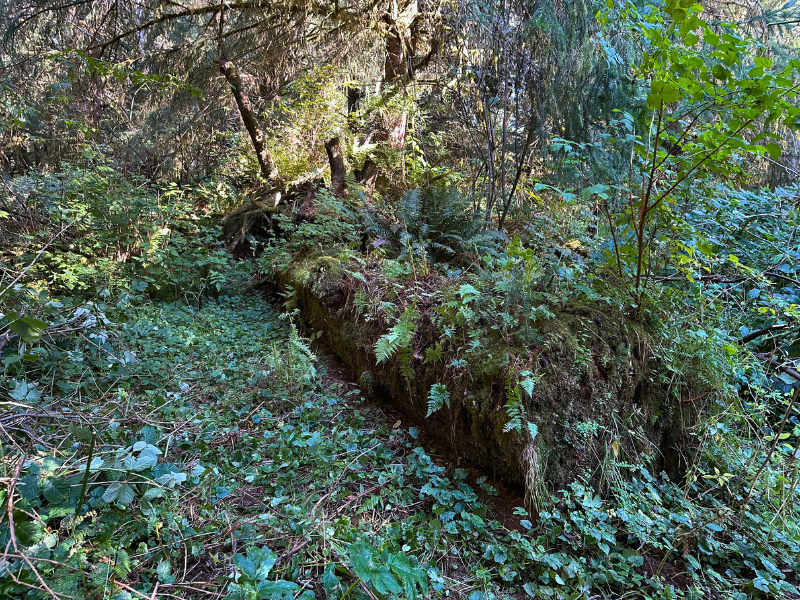
We looked at each other and then at the sawed-off stub of the trunk that was between the two of us. It was still in pretty good shape. This measurement would be easy. The trunk was 42 inches in diameter!
For a little perspective, I have a large Douglas-fir in my yard in Portland that’s about 125 ft tall. It’s a nice tall tree in the urban canopy. Out of curiosity, I measured its circumference and calculated its diameter at breast height (4’6” above the ground). That diameter was 39 inches. Our tree here at Circle Creek had divided into two trunks that were each slightly larger than this, but our measurement today is at an imagined height of 117 feet! This was what you might call a “Holy Cow” moment. Both of those world record trees over at Klootchie Creek topped out at just more than 200 feet. The weather up there is just too violent and kept breaking the tops. That sounds about right for here too. It’s just hard to imagine this tree.
A Favorable Fate for Our Spruce
We humans through time have been pretty hard on trees. They get in the way of our best laid schemes. And the wood they invented has long since been our most useful natural resource. But try as I might, I can’t imagine what would cause anyone to cut down this tree. In the first place, it doesn’t seem to have had much useful timber for its massive size. And also, just getting this huge tree out of the woods and to a mill would have been very difficult indeed, especially in 1918. Back then the Spruce Division quickly realized the best way with these large trees was to rive the trunks (that is to split the bucked sections into cants using manual tools, and then to haul the smaller pieces out on trucks, not by rail). Their average tree size was much smaller than these giants, about four feet in diameter. That’s still a big tree, but actually closer in size to the top of this tree that’s missing. I’ve seen photos of loggers, including from the Spruce Division, standing proudly atop huge stumps like ours as if a sort of man-verses-tree battle had just been won. This may have been part of what happened here.
But in this case after the fall, the fates have been favorable. The tree-cutters either decided that what remained of this tree was not suitable for the lumber they needed, or more likely they just left as soon as the war ended. We’ll never know. Then the tree, left on the ground, managed to stay where it had fallen, through the ages, 107 years and counting, without getting bulldozed, cut up or set on fire; and then to be purchased by North Coast Land Conservancy. Now it gets to live out its natural life cycle. A good rule of thumb is that a tree takes about as much time to decay after it dies as it did to grow from a sprout. We’re talking hundreds of years here.
Today, right at that third cut of the bucking saw, where the trunk divides in two, there grows a new Sitka spruce that today is more than two feet in diameter. I first noticed this tree because of a large buttress root reaching down to the ground keeping the tree growing straight and strong. Just a few feet away is our little patch of yellow archangel that was our starting point today. We’ll be back.
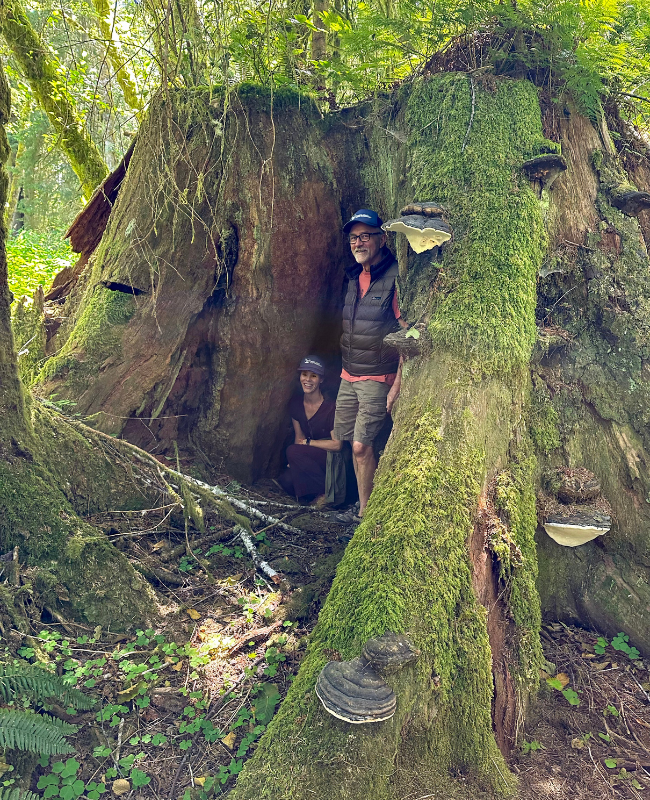
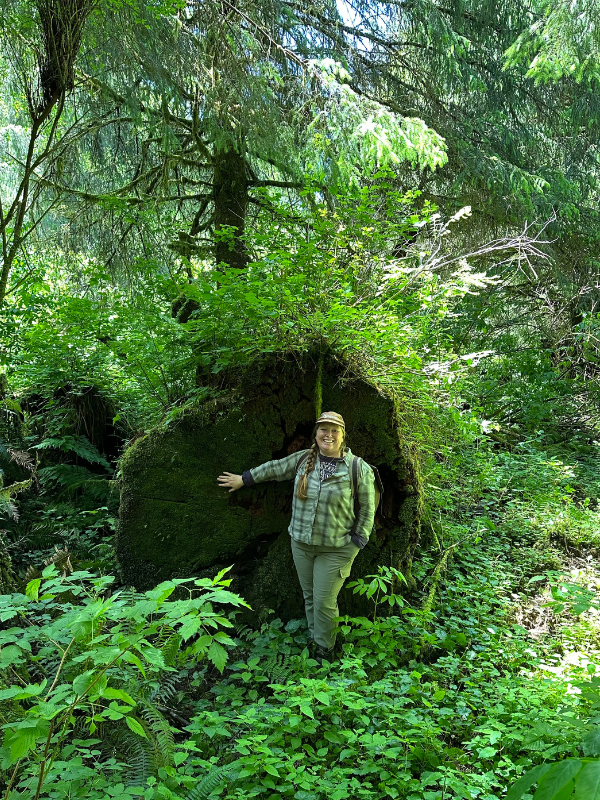
Of all the subjects in nature I’ve tried to photograph, the hardest by far is a tree. In talking with my friend Neal, I’m sure he would agree. It’s so hard to capture that feeling you have when you meet a tree out in the forest, especially those giants. For me that’s true to some extent even after they fall to the ground. I think they just lack context in a photograph.
The other day Kassia Nye, NCLC’s development director, invited me to join her and her family on a hike out on the Wetland Loop. We visited the “big stump” of course, and I took some photos. Here’s one of Kassia and her dad, Paul, that has some of that elusive tree magic.
Comments
Jeff, this is so interesting! Thanks for the effort you and Melissa put into this trek!