




Circle Creek Habitat Reserve is one of North Coast Land Conservancy’s most important protected areas for numerous reasons: It supports habitat connectivity for a diverse array of plants and wildlife, contributes to climate change resiliency, and connects the surrounding communities to place-based conservation efforts.
On Dec. 19, NCLC acquired approximately 24 acres to expand the organization’s existing 364-acre Circle Creek Habitat Reserve and adjacent 340-acre Boneyard Ridge Habitat Reserve. The land—previously owned by the Diment family—is located in the southern end of Seaside’s city limits, to the north and south of Rippet Road, which serves as the entrance from U.S. Highway 101 to NCLC’s Circle Creek Conservation Center.
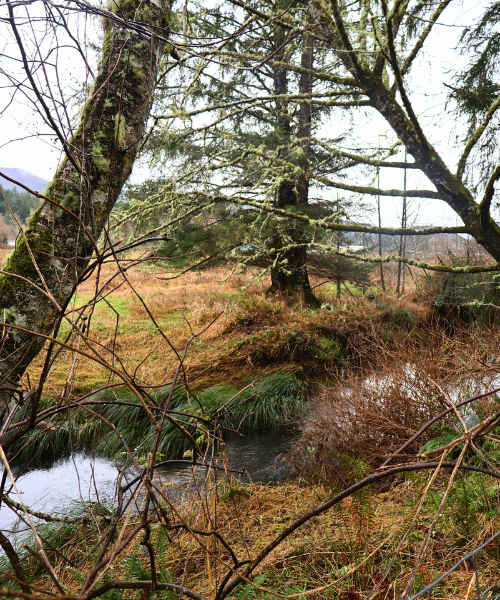
The newly conserved 23.85 acres are now part of a larger conservation corridor—spanning more than 3,000 acres from the Necanicum River to the Pacific Ocean—that includes Boneyard Ridge, Feldenheimer State Natural Area, Ecola State Park, rocky intertidal habitats, and a designated Marine Conservation Area.
Similar to the existing Circle Creek Habitat Reserve, the expansion property was previously managed as pasture land for livestock and horses, but it maintains high conservation potential, featuring an abundance of forested riparian areas containing larger Sitka spruce trees, as well as vital wetland zones.
Located in the heart of the Necanicum Wildlife Corridor, it plays a role in ensuring habitat connectivity southward, from Tillamook Head and Circle Creek Habitat Reserve, for elk and other wildlife.
The surrounding watershed includes land and tributaries that contribute to the Necanicum River as it flows from its headwaters—2,800 feet above sea level in the Coast Range—to the Pacific Ocean. Almost entirely forested (92%), the watershed provides critical habitat for many coastal plant and animal communities.
Additionally, the property contains about ½ mile of Circle Creek, which is considered essential salmon habitat by the Oregon Department of Fish & Wildlife. In general, the Necanicum Watershed supports endangered coho salmon, in addition to coastal cutthroat and steelhead. Two species of lamprey (Brook and Pacific) are also present, as well as several other fish species—including sculpin, flounder and perch—in the Necanicum Estuary.
The acquisition perfectly aligns with NCLC’s goals around connectivity and augments an ever-growing corridor of coastal conservation along the Necanicum River. With the expansion, NCLC will be poised to carry forward several more decades of volunteer-driven stewardship to restore Circle Creek, its riparian corridor and floodplain, and the watershed.

Comments